
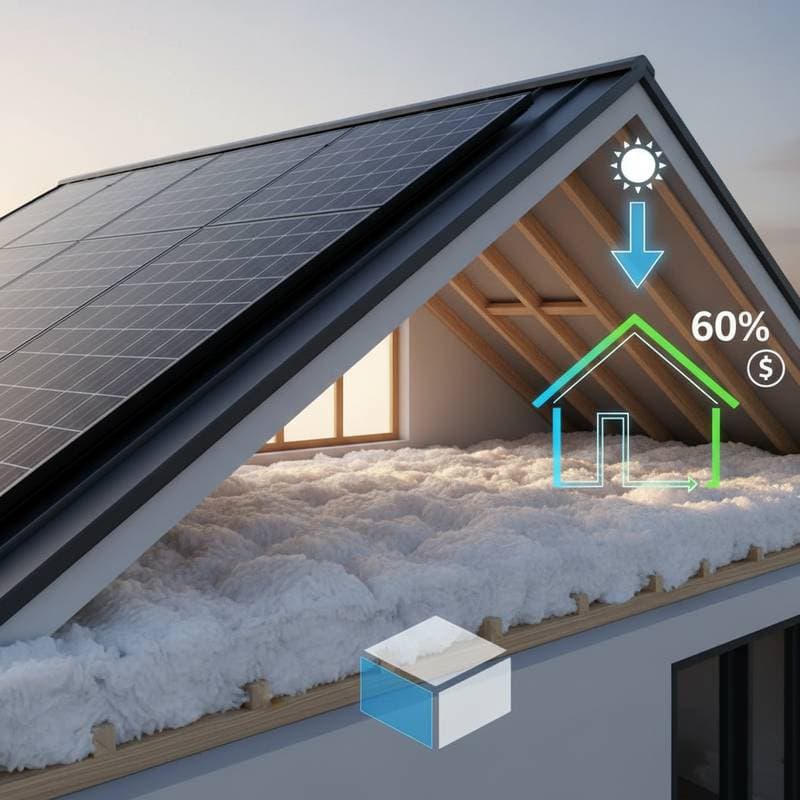
Maximize Savings: Attic Insulation Before Solar Panels
Homeowners seeking effective methods to lower energy costs often explore attic insulation and rooftop solar installations. When implemented in the proper sequence, these enhancements can reduce household energy expenses by up to 60%. Each component addresses a distinct aspect of energy management, forming a layered approach that amplifies overall effectiveness and sustains savings over time.
Establish a Strong Foundation with Attic Insulation
An effectively insulated attic serves as the cornerstone of a home's energy efficiency. Attics frequently represent the primary pathway for heat exchange, permitting heated air to escape during winter months and external heat to infiltrate in summer. Inadequate insulation compels heating, ventilation, and air conditioning systems to operate more intensively, which elevates utility bills and accelerates equipment wear.
High-quality insulation forms a robust thermal barrier that maintains consistent indoor temperatures. This adjustment lightens the load on HVAC units and curtails unnecessary energy expenditure. In typical residences, attic insulation upgrades yield reductions in heating and cooling expenses ranging from 15% to 25%, with noticeable impacts appearing promptly on utility statements.
Enhance Impact with Solar Integration
After addressing energy leakage via insulation, solar panels deliver heightened returns. These systems produce electricity to counterbalance grid reliance, yet their benefits intensify in homes that already consume energy judiciously. A properly insulated structure demands less power for climate control, allowing solar output to cover a greater proportion of requirements.
This interaction forms an efficiency stack, a term used by energy experts to describe sequential improvements that compound advantages. Insulation diminishes overall consumption, and solar provides renewable power for the balance. The result is a cohesive framework that fosters profound, lasting reductions in costs.
Quantify the Synergistic Benefits
The projected 60% savings arise from integrating the individual efficiencies of each upgrade. Insulation typically lowers usage by approximately 20%, and solar systems can offset 40% or more of the adjusted utility needs, culminating in savings that surpass 50% of original expenditures.
Consider a household with monthly energy costs of $200; after both installations, bills might decrease to about $80. Outcomes vary based on factors such as regional weather patterns, dwelling dimensions, insulation specifications, and solar array scale. Nonetheless, data from diverse locales indicate that combined implementations consistently surpass single upgrades in performance.
Select Optimal Insulation Materials
Insulation options differ in efficacy and suitability. Fiberglass batts offer economical solutions for standard applications, whereas blown-in cellulose excels in filling voids within uneven areas. Spray foam provides superior sealing against drafts, enhancing airtightness and thermal resistance.
Engage certified professionals to assess current insulation depth, pinpoint deficiencies, and suggest materials aligned with the home's architecture and financial constraints. Key considerations include R-value ratings, which measure resistance to heat flow; aim for R-38 to R-60 in most climates for optimal results.
Correct placement proves essential. Substandard application, such as compression or uneven distribution, diminishes effectiveness. Experts frequently employ infrared cameras to reveal inconsistencies and verify uniform application over attic surfaces and structural elements.
Design Solar Systems for Post-Insulation Needs
With insulation in place, evaluate and install a solar array calibrated to the home's updated consumption profile. Excess capacity leads to unnecessary expenses, whereas insufficient sizing curtails offsets. Precise planning involves reviewing revised usage data, roof pitch and direction, and potential obstructions from trees or buildings.
Advanced applications enable real-time oversight of energy generation and usage, illustrating the interplay between insulation and solar contributions. Certain installers provide comprehensive services encompassing audits, insulation enhancements, and photovoltaic setups, streamlining the transition to integrated efficiency.
Sustain Advantages Over Time
Beyond immediate financial relief, these upgrades elevate living quality. Insulation mitigates drafts and acoustic disturbances, fostering even temperatures throughout the year. Solar installations increase real estate appeal and protect against escalating energy prices.
The duo yields environmental merits by curbing carbon emissions and reliance on fossil fuels. Insulation endures for 30 to 50 years if shielded from dampness, and solar panels require only routine cleaning and annual checks to maintain output. This low-maintenance configuration ensures reliable performance and ongoing returns.
Implement Your Energy Optimization Plan
Combining attic insulation with solar panels ranks among the most economical measures for managing household energy outlays. These elements reinforce one another to secure comfort, reduce waste, and promote fiscal resilience.
Begin with a professional energy assessment to baseline current performance. Proceed to insulate the attic, then configure a solar system suited to the optimized profile. This methodical strategy maximizes investment returns, yielding a residence that excels in efficiency, livability, and preparedness for evolving energy landscapes.