
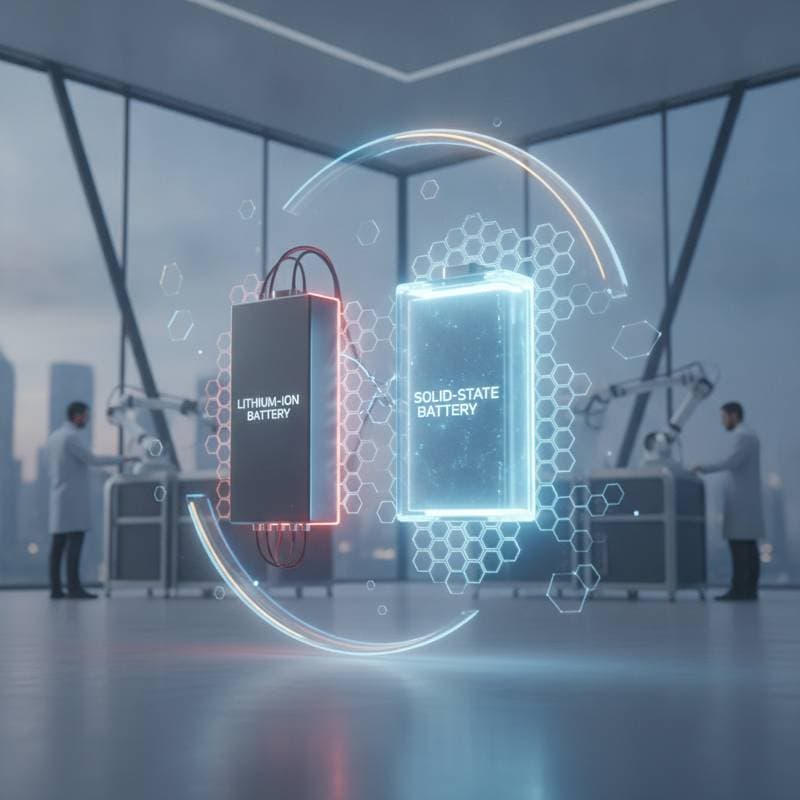
Solid-State vs Lithium: Key 2026 Battery Differences
Battery technology continues to evolve as manufacturers seek higher density, faster charging, and improved safety. Two technologies dominate the conversation in energy storage. Solid-state batteries are viewed as the next major step, while lithium-ion remains the established commercial standard. Understanding the differences between these two systems helps developers, installers, and energy professionals prepare for the next phase of battery deployment.
Core Structural Differences
At the heart of both technologies lies a similar goal: converting chemical energy into electrical energy efficiently and safely. The distinction begins with the electrolyte. Lithium-ion batteries use a liquid or gel electrolyte that allows ions to move between the anode and cathode. Solid-state batteries replace this liquid with a solid electrolyte made of ceramic, glass, or specialized polymers.
This structural shift alters nearly every performance characteristic. Solid-state systems are expected to provide higher energy density by enabling the use of metallic lithium anodes. They also reduce the risk of leakage or thermal events since the solid electrolyte is nonflammable. In contrast, lithium-ion cells rely on stable liquid electrolytes that are easier to manufacture but more prone to safety concerns if damaged.
Energy Density and Performance
Energy density remains one of the most important differentiators between the two chemistries. Solid-state batteries can theoretically store more energy in the same volume. This allows for longer driving ranges in electric vehicles, smaller battery packs in consumer devices, and more compact stationary storage systems. The gain comes from the ability to use pure lithium metal anodes, which store more charge than the graphite anodes used in lithium-ion cells.
Lithium-ion still performs well in terms of power delivery and has a well-established performance record. Manufacturers have improved these systems through innovations in cathode materials, electrolyte additives, and manufacturing precision. While solid-state technology promises higher density, it must still demonstrate that it can deliver consistent power output over thousands of cycles in commercial conditions.
Safety and Stability
Thermal stability is one of the strongest selling points for solid-state batteries. The solid electrolyte eliminates the liquid component that can vaporize or ignite under stress. This makes the cells less likely to overheat or experience runaway reactions. As a result, manufacturers can design more compact packs with fewer layers of protective shielding.
Lithium-ion technology has made progress on safety, but its reliance on liquid electrolytes still introduces risks under certain conditions. Modern management systems and improved cell chemistry have greatly reduced incidents. Even so, the perception of safety remains a key motivator for companies investing heavily in solid-state research and pilot production.
Manufacturing and Cost Considerations
The path to large-scale production for solid-state batteries is still developing. Traditional lithium-ion manufacturing lines are mature, with optimized processes and global supply chains. Solid-state fabrication requires new materials, specialized environments, and redesigned equipment. These factors increase current production costs and slow down commercialization.
Manufacturers are experimenting with hybrid designs that combine features of both systems. Some use semi-solid electrolytes to bridge the gap between liquid and solid states. These transitional technologies may help the industry move toward full solid-state adoption by testing material performance under scaled conditions while retaining some advantages of existing lithium-ion infrastructure.
Charging and Longevity
Solid-state batteries are often projected to charge faster and last longer. The solid electrolyte can tolerate higher voltages and temperatures without degrading as quickly as liquid-based systems. Early prototypes have shown potential for thousands of charge cycles with minimal capacity loss. This could extend the operational lifespan of electric vehicles and stationary storage units.
Lithium-ion batteries, while reliable, suffer from gradual capacity fade due to chemical breakdown in the liquid electrolyte and electrode interfaces. Advanced management systems help slow this decline, but degradation remains a limiting factor. The challenge for solid-state technology is to maintain its projected longevity under real-world conditions, where temperature fluctuations and repeated cycling can reveal weaknesses in cell materials.
Market Readiness and Commercial Outlook
Industry analysts expect a gradual transition instead of an immediate shift. Lithium-ion will continue to dominate large-scale production for energy storage, electric mobility, and consumer electronics. Its cost advantages and established supply networks are difficult to replace in the short term.
Solid-state technology, on the other hand, is moving through prototype and pilot manufacturing phases. Automakers, battery developers, and material suppliers are investing heavily in research partnerships. Early commercial applications may appear in premium products where higher performance and safety justify the cost. Broader adoption will depend on reducing material expenses and improving manufacturing yield.
Environmental and Resource Implications
Both technologies share similar raw material challenges, including reliance on lithium and other critical minerals. Solid-state designs may reduce the need for cobalt, an element with supply chain and ethical sourcing concerns. They can also support thinner, lighter cells that require fewer materials overall. Recycling methods for solid-state batteries are still emerging, but the simpler structure could eventually improve recyclability.
Lithium-ion recycling is more mature, with several established recovery processes already operating at scale. Any transition to solid-state production will need to account for material compatibility and recycling infrastructure adjustments. The long-term sustainability of energy storage depends on how efficiently these materials can be recovered and reused.
Scaling Solid Electrolyte Production
Solid-state batteries represent a promising evolution in energy storage, offering higher density, greater safety, and potentially longer lifespans. Yet the proven reliability, cost efficiency, and scalability of lithium-ion systems ensure they will remain essential for years to come.
As pilot factories mature and early commercial deployments take shape, the industry will gain clearer data on how solid-state batteries perform outside laboratory conditions. The transition will not happen overnight, but each breakthrough in materials and manufacturing brings the technology closer to mainstream viability.