
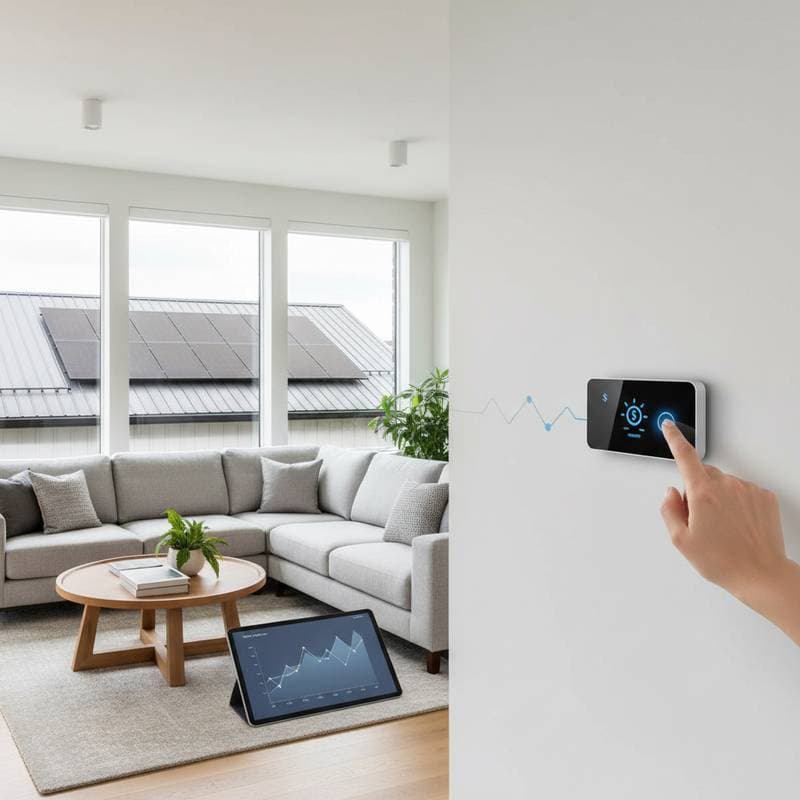
Combine Smart Thermostats and Solar for $1,200 Savings
Homeowners who integrate solar power with smart thermostats report clear reductions in annual energy costs. Utility rebate data indicate that households using both systems can lower yearly expenses by as much as $1,200. The savings depend on system capacity, local rates, and usage habits. Energy analysts view the pairing as a direct route to automated home energy management.
Precision Control Meets Renewable Generation
Solar panels supply electricity for household systems including heating and cooling. A smart thermostat directs when and how that power is applied. Synchronization lets the thermostat shift HVAC operation according to real-time solar output, rate schedules, and occupancy.
Laura Bennett, Director of Product Strategy at EcoLogic Energy Systems, states that intelligent controls paired with on-site generation form a closed loop that improves investment returns. The thermostat functions as an active energy coordinator rather than a simple temperature switch.
Models from Google Nest, Ecobee, and Honeywell Home exchange data with inverters through Wi-Fi or utility demand-response interfaces. The setup permits pre-cooling or pre-heating during peak solar production and reduces HVAC activity when output falls or grid prices rise.
Quantifying the Savings
A typical residence equipped with a 7 kW solar array offsets 60 to 80 percent of its electricity demand. Addition of a smart thermostat trims another 10 to 20 percent of remaining use. For households that spend roughly $2,500 each year on power and heating, the extra reduction yields $250 to $500. Time-of-use scheduling and demand-response payments can push combined annual savings to $1,200 or higher.
EnergySage analysis shows that homes combining the two technologies recover costs nearly two years sooner than those adopting either measure alone. Lower peak demand also lengthens HVAC service life by cutting unneeded cycles.
Installation and Integration Considerations
Linking a smart thermostat to a solar system requires no extensive rewiring, yet it needs precise setup. Installers confirm that the thermostat energy features match the inverter communication protocol. Current units commonly support Modbus or Zigbee standards for direct data transfer.
Michael Ortiz, Chief Technical Officer at SunGrid Solutions, advises that the thermostat must be included in solar commissioning. Accurate calibration allows the device to recognize available solar generation and decide when to draw from storage or the grid.
Battery storage adds further options. The thermostat can align with battery controls to run heating or cooling while solar output is strong and hold stored energy for later hours. Certain utilities provide payments for this coordinated shifting, especially where peak prices fluctuate.
Policy and Utility Program Support
Utilities in multiple states now expand rebates that reward thermostat and solar integration. Typical offers include $100 thermostat incentives plus credits for demand-response participation that eases grid stress.
Department of Energy guidelines promote standards for data exchange between distributed resources and home automation. These rules position solar-compatible thermostats as standard elements in future residential packages.
Consultant Rachel Kim of GreenEdge Advisors notes that utilities see household-level control as less expensive than new central infrastructure. Solar homes with connected thermostats function as useful grid resources.
Market Growth and Business Opportunities
Wood Mackenzie forecasts that more than one-third of new solar customers will add at least one connected energy device in the coming cycle. Manufacturers now produce thermostats that link directly to solar monitoring applications, displaying generation, consumption, and HVAC data on a single screen.
Solar contractors gain an advantage by including thermostat integration. The service offers a modest-cost upgrade that produces measurable savings and raises customer satisfaction. Some firms bundle thermostats with standard residential packages and present them as optimization tools.
HVAC contractors and retailers coordinate with solar providers to offer combined equipment and maintenance plans. The approach improves retention and generates ongoing service income.
Technical Advantages for Installers and Users
Smart thermostats supply detailed performance data. Installers review HVAC activity and solar output through cloud platforms, spotting inefficiencies or equipment issues early.
Homeowners receive steadier comfort. Occupancy sensors and location-based rules adjust temperatures only when the house is in use. Forecasts of solar production prevent unnecessary operation during low-output periods.
Integrating Controls for Long-Term Efficiency
Solar arrays and smart thermostats form an initial layer of residential energy automation. As electric-vehicle chargers, water heaters, and batteries join the network, the thermostat remains the central coordination point. Installers who adopt the method now prepare for continued expansion in automated, efficient homes. Homeowners obtain lower bills, smaller emissions, and clearer oversight of energy use.