
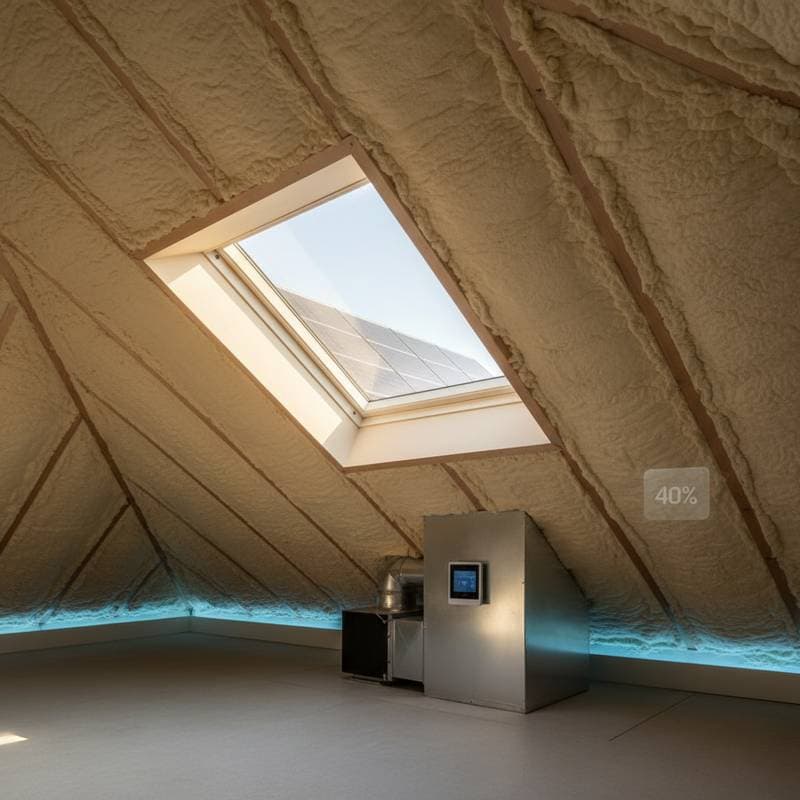
Spray Foam Attics Unlock 40% More Solar Savings
Energy efficiency starts at the roof. Homeowners and building professionals who invest in solar panels find that attic insulation performance directly impacts the value delivered by photovoltaic systems. Field data and building science studies indicate that spray foam insulation in attics boosts solar energy savings by up to 40 percent over traditional materials. These gains arise from minimized thermal losses, stabilized indoor temperatures, and more predictable conditions for solar operations.
This link between insulation and solar performance reshapes planning for integrated energy upgrades among contractors, developers, and homeowners. Spray foam insulation moves beyond mere comfort enhancements to serve as a strategic element for maximizing financial and operational returns from rooftop solar systems.
How Spray Foam Enhances Solar Efficiency
Traditional methods such as fiberglass or cellulose use air-permeable materials that slow heat transfer yet fail to seal building envelope gaps completely. Spray foam expands to fill cavities and crevices, forming an airtight barrier that curbs heat movement and air infiltration. This sealing prevents conditioned air from escaping into attics, which often represent the hottest or coldest home zones.
Integrated with solar systems, this sealed envelope alters the building energy balance. Systems sized for poorly insulated homes compensate for energy waste by working harder. Spray foam in the attic sharply reduces cooling and heating demands, which lowers HVAC electricity use and directs more solar output toward other loads or grid export. Net savings from the solar investment thus improve measurably.
Quantifying the 40 Percent Advantage
Energy modeling from various retrofit projects reveals a clear pattern. Homes equipped with spray foam attic insulation reduce total energy use by up to 25 percent compared to those with fiberglass or blown-in cellulose. Combined with solar generation, net energy savings rise by 35 to 40 percent. Variations occur based on climate zone, roof type, and system size, yet the pattern holds across regions.
In hot climates, where attic temperatures soar, spray foam maintains attic air within ten degrees of indoor levels. This eases air conditioning strain and cuts peak-hour energy draw. Solar systems, active during these peaks, offset more demand and yield stronger financial returns. In cooler areas, spray foam blocks roof heat loss, elevates baseline efficiency, and extends solar energy utility through heating seasons.
The Building Science Behind the Savings
Spray foam provides two primary benefits that influence solar savings: air sealing and moisture management. Air leaks through cracks and seams contribute significantly to energy loss. Spray foam eliminates these, stabilizes temperatures, and decreases HVAC cycling frequency. Reduced cycling conserves electricity and eases mechanical system wear.
Moisture management plays a vital role as well. Closed-cell spray foam acts as a vapor barrier, restricting humidity flow through the roof assembly. Dry insulation sustains its R-value over time for reliable performance. A stable roof also shields solar wiring, racking, and components from moisture damage.
Field monitoring of spray foam-insulated attics confirms these advantages. Interior temperatures stay consistent amid outdoor fluctuations. Such stability enables solar systems to function under reliable conditions, refining energy models and payback estimates.
Design and Installation Considerations
Solar and insulation professionals must coordinate closely. Spray foam application alters attic ventilation and thermal loads. Sound design preserves structural integrity and safe mechanical operation. Builders select open-cell or closed-cell foam based on roof design, climate, and moisture risks.
Open-cell foam, lighter and more affordable, suits most residences where moisture poses minimal threat. Closed-cell foam offers superior air and vapor barriers, ideal for humid zones or metal roofs. Both apply directly to roof deck undersides, converting attics into semi-conditioned spaces.
Installing spray foam prior to solar mounting reinforces the deck and seals penetrations. This approach cuts long-term maintenance and bolsters solar roof durability. Coordinated trade efforts during design and installation simplify projects and eliminate overlap.
Financial Payback and Long-Term Value
Spray foam costs more upfront than fiberglass or cellulose, yet pairs with solar to accelerate returns. Immediate HVAC savings from lower demands allow solar to cover more consumption. This compounding yields greater cumulative benefits over time.
Financing options for combined upgrades often access efficiency incentives and tax credits. State and utility programs qualify spray foam as an efficiency measure. Alongside solar rebates, these shorten payback and elevate lifetime value.
Resale markets favor homes with sealed attics and solar. Buyers value enhanced comfort and utility savings. Developers integrating spray foam in new builds improve energy ratings, appealing to eco-aware purchasers.
Environmental and Operational Benefits
Spray foam attics advance sustainability by curbing HVAC energy, which reduces emissions from power generation. Enhanced thermal performance aids utilities in smoothing peak loads during weather extremes.
Solar owners gain from less equipment stress. Cooler attics prevent inverter and wiring overheating, prolonging lifespan. In cold regions, warmer attics avert ice dams, safeguarding roofs and solar gear.
Improved indoor air quality emerges as another plus. Sealed attics block dust, pollen, and pollutants from entering living areas. Residents enjoy fewer drafts and steady humidity, boosting comfort without extra filters.
Integration with Modern Solar Design
Integrated energy systems prompt closer collaboration among solar firms, insulation experts, and performance specialists. These teams design packages for dependable outcomes, factoring in production and conservation for precise sizing and satisfaction.
Advanced tools simulate insulation and solar effects. Inputs like R-values, leakage rates, and roof traits forecast pre- and post-installation demands. Customers visualize added value, often opting for smaller systems post-insulation to meet goals.
Contractors expand services by bundling spray foam, standing out competitively. This mitigates underperformance risks from leaky envelopes, fostering client trust.
Steps to Integrate Spray Foam with Solar
Property owners eyeing solar should audit attics first. Professionals identify leaks, gaps, and moisture to pinpoint efficiency drags. Upgrading to spray foam pre-solar maximizes both systems.
Solar contractors partner with insulation teams for efficiency. Joint audits, scheduling, and pricing deliver smooth experiences and superior results. Client education on insulation-solar synergy informs choices.
Builders embed spray foam in new projects for strong baselines. Pairing with reflective roofs and optimal panel placement yields year-round energy production and conservation.
Spray foam tightens envelopes, cuts thermal loss, and steadies conditions, enabling solar to maximize returns.