
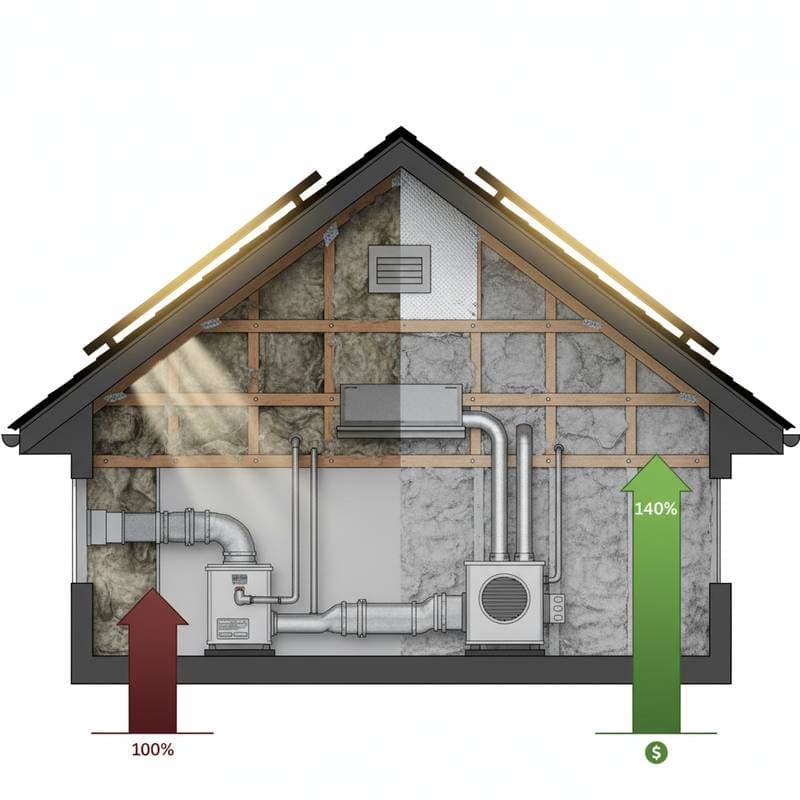
Why Attic Insulation Outperforms Solar ROI by 40 Percent
Homeowners often consider solar panels as the primary step toward energy efficiency. These installations serve as a visible symbol of sustainability. However, attic insulation provides a superior return on investment in numerous scenarios. Research in the United States residential energy sector indicates that insulation yields quicker payback periods, reduced initial expenses, and reliable long-term savings. Properly installed attic insulation enhances overall home energy ROI by approximately 40 percent relative to solar installations alone.
The Impact of Effective Heat Retention
Solar systems generate power, yet they must counteract energy losses from inadequate insulation. Heat escapes through poorly insulated attics, compelling heating and cooling systems to operate more intensively. The United States Department of Energy reports that households lose up to 25 percent of conditioned air via unsealed attics. This loss translates to direct financial waste, irrespective of solar production levels.
Homes equipped with advanced solar arrays frequently incur high utility costs due to attic air leaks. Sealing these gaps prior to solar installation extends the value of generated power. Reduced overall energy consumption allows each watt from solar to offset a larger share of needs. This interaction explains the substantial ROI boost from insulation. The upgrades complement each other, with insulation as the essential precursor.
Comparing Costs, Payback Periods, and Economic Realities
Solar panels represent advanced technology, yet they demand significant upfront capital. Declining panel prices help, but installation and permitting fees accumulate rapidly. Attic insulation achieves tangible outcomes at considerably lower cost. In various regions and based on current conditions, a well-insulated attic recovers its expense within two to four years. Solar initiatives typically require double that duration to break even.
Examining comprehensive returns highlights insulation's edge. It targets the dominant share of home energy use: heating and cooling. Solar addresses electricity alone. In regions with extended winters or intense summers, HVAC demands prevail, enabling attic sealing and insulation to cut total usage by 20 to 40 percent. Consequently, the required solar array shrinks in size, expense, and operational demands.
A contractor in Colorado shared that approximately half of solar clients later sought insulation enhancements. Many expressed surprise at modest solar savings until thermal leaks received attention. Post-insulation, panels delivered anticipated results. This pattern emerges across diverse climate zones.
Insights from Energy Modeling
Energy auditors rely on simulation software to predict building performance. Data consistently favors insulation. For identical homes, one with insulation upgrades and the other with equivalently priced solar panels, the insulated version exhibits greater reductions in total energy consumption. The solar home produces renewable energy, but inefficiencies in the building envelope diminish its impact.
Insulation improvements enhance comfort and equipment durability. HVAC systems cycle less frequently, prolonging their lifespan. This indirect benefit yields substantial economic gains, frequently overlooked in basic ROI assessments. Across 10 to 20 years, reduced maintenance and replacements save thousands of dollars.
Factors Driving Solar's Prominence
Psychological elements contribute to solar's appeal. Panels offer visibility, modernity, and promotional allure. Insulation resides unseen in the attic, escaping notice. Individuals prefer concrete innovations and self-generated energy concepts. Solar marketing thrives, whereas insulation receives limited promotion. Technically, insulation forms the efficiency base. Absent it, all systems strain excessively.
At industry events, solar exhibitors command vast spaces, while insulation providers occupy modest areas. This disparity mirrors societal views. Experienced energy auditors, when consulted on starting points, direct attention to the attic. It stands as the most economical enhancement before solar adoption.
Combining Insulation and Solar for Optimal Results
This discussion does not oppose solar energy. Solar excels alongside a sealed, insulated structure. Minimized heat loss permits precise solar sizing to match actual demands. Fewer panels result, along with decreased costs and improved efficiency. Neglecting insulation leads to oversized arrays that offset preventable waste.
The principle centers on conservation preceding generation. Each kilowatt-hour conserved via insulation costs less than one . Integrated installations often exceed individual system ROIs. Insulation maintains stable temperatures, while solar supplies renewable power for the diminished load. This collaboration optimizes comfort and finances.
Climate-Specific Benefits and Material Options
Attic insulation's superiority adapts to local conditions, yet benefits persist broadly. In northern states with cold weather, it blocks heat loss at the roof deck. In southern hot climates, it prevents attic heat transfer to living areas. Savings materialize quickly and quantifiably in both scenarios. Materials like blown cellulose, spray foam, and fiberglass batts provide tailored performance, far surpassing outdated, insufficient attic fills.
In humid zones, insulation manages moisture to avert condensation damage. This safeguard bolsters structural longevity, enhancing economic worth. Beyond energy reduction, a fortified attic preserves roofing and framing integrity.
Steps for Implementing Efficiency Improvements
Homeowners eyeing solar should initiate with a professional energy audit. Tools such as infrared imaging and blower door testing pinpoint air infiltration sites. If attic insulation falls below guidelines or leaks appear near ducts and vents, address them before solar commitment. Optimizing the energy profile refines solar specifications and financial projections.
A structured upgrade path includes:
- Conduct an energy assessment to pinpoint inefficiencies.
- Seal air paths at attic floors, ducts, and vents.
- Install insulation suited to climate depth and type.
- Evaluate HVAC to align capacity with the enhanced envelope.
- Design and install solar based on adjusted energy needs.
This sequence maximizes savings per investment dollar.
Achieving Lasting Energy Savings Through Prioritized Upgrades
Prioritizing attic insulation establishes a foundation for sustained efficiency. Homeowners gain immediate reductions in energy loss, enhanced comfort, and amplified solar effectiveness. This approach delivers superior financial returns while supporting environmental goals. Begin with an audit to unlock these benefits today.