
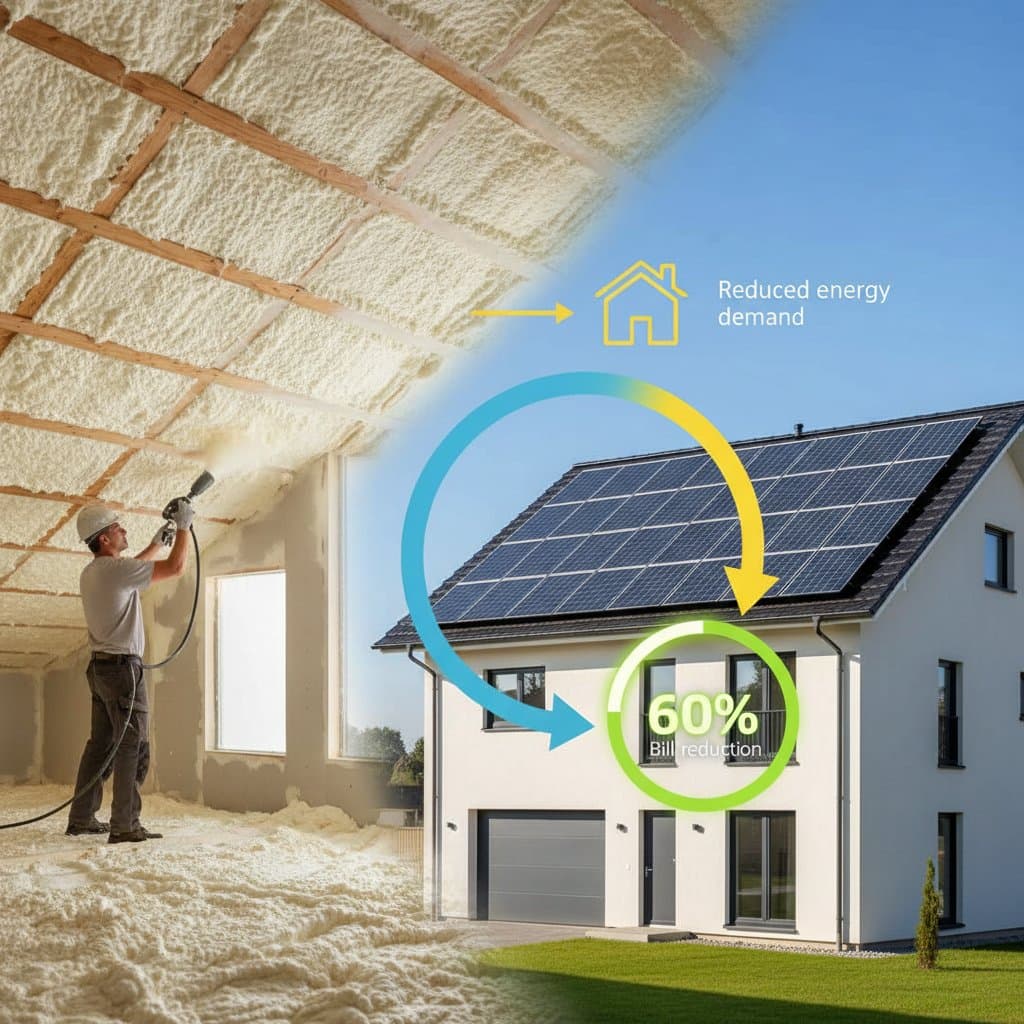
Achieve 60% Energy Bill Reductions with Spray Foam and Solar Integration
Energy efficiency discussions often focus on individual upgrades such as solar panels or insulation. However, integrating spray foam insulation with rooftop solar panels emerges as a superior strategy for residential energy cost reduction. Recent case studies demonstrate that homeowners implementing this combination achieve utility bill savings of approximately 60 percent compared to prior expenses. The underlying science and economic principles support this outcome clearly.
The Superior Performance of Spray Foam Insulation
Spray foam insulation has evolved significantly over the last decade. Closed-cell spray foam creates an airtight seal that eliminates gaps and cracks allowing air movement. Unlike traditional fiberglass or cellulose options, which merely impede heat transfer, spray foam halts it entirely. This action prevents conditioned air from escaping while barring external heat or cold from entering, thereby maintaining stable indoor temperatures with greater effectiveness.
Residential energy audits reveal a consistent issue across numerous homes. Significant efficiency losses stem from air infiltration in attics, crawl spaces, and wall cavities rather than outdated HVAC systems or lighting. Spray foam targets these vulnerabilities precisely, reducing air infiltration by up to 80 percent. Consequently, heating and cooling systems operate with reduced effort to sustain comfort levels.
This efficiency improvement establishes a lower energy baseline. Even without solar integration, monthly bills decrease noticeably. When combined with solar generation, the financial benefits amplify substantially.
Enhancing Solar Effectiveness Through Insulation
Solar panels deliver optimal results in homes with minimized energy consumption. A reduced reliance on grid electricity shortens the payback period for solar investments. Homeowners who install spray foam prior to solar sizing often decrease the necessary panel capacity by about one-third, lowering equipment and installation expenses directly.
Consistent indoor temperatures further optimize solar performance. Air leaks cause frequent HVAC cycling, which elevates usage during peak periods. Spray foam mitigates this by stabilizing thermal conditions, enabling solar power to offset a larger portion of overall demand. Homes progress toward near-complete energy independence as a result.
Quantitative analysis underscores the partnership. Insulation alone may lower energy use by 30 to 40 percent in a typical household. Solar then addresses the residual needs, yielding total bill reductions of 60 percent or greater, influenced by regional utility rates and weather patterns.
Insights from Homeowner Implementations
Interviews with homeowners in diverse regions highlight tangible outcomes. A family in a humid coastal area reported a 40-degree Fahrenheit drop in attic temperatures following closed-cell spray foam installation. Their air conditioner previously operated nearly continuously on summer afternoons; post-upgrade, runtime halved. Adding a 7-kilowatt solar array tailored to the diminished load reduced their monthly electric bill from over $200 to under $80.
In a northern climate with harsh winters, another homeowner experienced parallel benefits. Heating costs decreased sharply after spray foam sealed the basement and rim joists. Solar generation met daytime electrical requirements, while lowered heating needs minimized furnace operation. Both cases noted enhanced comfort, reduced expenses, and quieter interiors due to the foam's sound-dampening properties.
Engineering Principles Driving the Combined Benefits
Each technology enhances the other in this integration. Spray foam diminishes the overall energy load, and solar offsets that load with renewable electricity. Shorter HVAC runtimes prolong equipment durability, reducing future maintenance expenditures. Additionally, spray foam controls humidity levels, which supports solar inverter efficiency and prevents corrosion in moist settings.
Financial incentives reinforce the approach. Programs offer tax credits and rebates for both insulation and solar projects. Bundling these under a single financing plan simplifies processes and accelerates return on investment. Factoring in energy savings, incentives, and elevated property values shortens payback periods to several years.
Selecting Optimal Materials and Professionals
Product selection influences outcomes significantly. Closed-cell spray foam offers superior R-values and moisture resistance, suiting most environments. Open-cell variants perform well in interior applications but do not provide equivalent vapor barriers.
Engage contractors experienced in both domains. A solar specialist collaborating with an insulation expert ensures accurate array sizing aligned with post-insulation efficiency gains.
- Conduct a professional energy audit to pinpoint leaks and inefficiencies.
- Prioritize closed-cell foam for exterior barriers in variable climates.
- Verify installer certifications for spray foam application and solar NABCEP accreditation.
- Explore bundled financing options for combined projects.
Steps to Implement Your Efficiency Upgrade
Homeowners committed to utility cost reductions find this pairing among the most effective investments. The strategy addresses consumption reduction and power generation simultaneously. Immediate comfort gains accompany accumulating financial advantages.
Successful initiatives start with a comprehensive energy audit identifying air infiltration, insulation deficiencies, and usage profiles. Proceed to apply spray foam for sealing, then design a solar system scaled to the optimized load. This methodical process leverages proven principles for maximum impact.